
Chattanooga Voter Lookup Fields
The official Tennessee Voter Registration Information Lookup is a personal confirmation tool. It is not a browseable list of every Chattanooga voter. The screen states that its data have a current-as-of date, and every identity field must be completed. Select Hamilton County for a Chattanooga address. Then supply the registrant’s first name, last name, birth month, and birth year.
| Lookup control | Input type | Needed? | How Chattanooga voters use it |
|---|---|---|---|
| County | Dropdown | Yes | Choose Hamilton County |
| First Name | Text | Yes | Enter the voter’s personal information |
| Last Name | Text | Yes | Use the registered surname |
| Birth Month | Dropdown | Yes | Select the month |
| Birth Year | Dropdown | Yes | Select the year |
Those five fields prevent surname browsing. They also mean a spelling change, recent move, or wrong county can produce no match. Check the entries once. If the Chattanooga registration still does not appear, contact the Hamilton County Election Commission instead of treating the screen as proof of ineligibility. A recent application may still be processing, and an inactive or cancelled status requires context from the custodian.
Note: The lookup asks for a birth month and year to identify the voter; it does not publish a full date of birth.
Reading Chattanooga Voter Lookup Results
A successful result confirms the personal record and ordinarily supplies registration status, polling or precinct information, and political districts. GoVoteTN adds election-specific polling and ballot information. These returns answer practical questions about where and how a person may vote. They do not expose a downloadable history, a full birth date, a government identification number, or any marked ballot.
Read the current-as-of date before relying on the result. Precinct and district data can change after a move, boundary update, or processing event. Hamilton County staff remain the source for a correction or a firm answer about a recent transaction. The state screen and the county office serve different roles: one gives fast personal confirmation, while the other can inspect the underlying administrative record.
Does participation show a vote? No. An election history may show that someone took part in a named election. Ballot secrecy prevents it from showing the candidates or questions that person chose.
Chattanooga Voter Records: Public and Private
A Tennessee registration database can contain far more than the personal lookup displays. The underlying fields may include a full name and suffix, residence and mailing addresses, status and date, former registration facts, contact details, precinct, political districts, identification numbers, and participation history. Each field follows its own disclosure rule. Tenn. Code Ann. § 2-2-127 makes permanent records public, but it expressly shields Social Security and driver-license numbers.
| Name, status, precinct | Core registration and administration facts available through personal lookup or lawful records access |
|---|---|
| Residence address | A common list field, except when a protected program makes the actual address confidential |
| Registration date | An administrative field that may appear in voter data |
| Participation history | May identify elections in which the voter participated, never the ballot choices |
| Birth data and contact details | Sensitive fields whose release depends on the record and a specific election-law exception |
| SSN and driver or DHS ID | Confidential identifiers excluded from public registration records |
Tennessee keeps key fields confidential. Tenn. Code Ann. § 2-2-127 excludes Social Security and driver-license numbers. Section 2-6-502(b) also protects SSN, birth date, mailing address, and email on specified absentee or temporary-registration applications. Protected-program addresses receive added safeguards.
A requester should ask for lawful redactions rather than seek a complete database dump. For the broader state-law framework governing public records, use the Chattanooga public records access overview. Election statutes still control where their terms are more specific.
Tennessee Party and Participation Records
Tennessee does not register voters by political party. A Chattanooga voter record therefore has no official party-affiliation field comparable to one used in a party-registration state. Primary participation must not be relabeled as party membership. A person may choose an eligible primary ballot under election rules without creating a permanent party registration.
This difference matters in family research and civic analysis. “Participated” means the record reflects attendance or voting in that election. It says nothing about a candidate, slate, referendum response, or private political belief. The secret ballot remains secret even when the fact of participation is held as an administrative record.
Request Chattanooga Voter Registration Files
A compiled roll is not an unrestricted contact list. Tenn. Code Ann. § 2-2-138 governs computerized county lists and the statewide compilation. A requester must certify on the State Election Commission form that the data will be used for political purposes. A vendor may process data only to serve election officials, not for an independent use.
- Describe an existing file. State the as-of date, precinct scope, fields, and preferred electronic format. Ask whether participation history is a separate dataset.
- Confirm Tennessee citizenship for the public-record request and ask the coordinator which political-purpose certification must accompany it.
- Review the cost estimate. Copy requests require prepayment, and delivery may be by pickup, USPS, electronic transfer, or another approved method.
No special flat price for a Hamilton County voter file was published in the researched sources. The accurate fee is “estimate required.” The Commission may charge for copies, programming, delivery, labor, or redaction under its policy. It need not create a custom analysis that does not already exist.
Use the file only as certified. Do not republish protected fields, infer ballot choices, evade address safeguards, or use voter data to threaten or repeatedly contact a person. Tennessee harassment and stalking provisions include Tenn. Code Ann. §§ 39-17-308 and 39-17-315.
Hamilton Election Records Request Channels
Hamilton County accepts election-record requests through its online open-record form, by email at vote@hamiltontn.gov, by mail, or at the office. The Public Records Request Coordinator works at 700 River Terminal Road, Chattanooga, TN 37406. Hours are Monday through Friday, 8:00 a.m. to 4:00 p.m., and the main phone is 423-209-8683. The form asks for the request date, legal name, phone, email, Tennessee residency, mailing address, request type, delivery choice, a description, and an electronic signature. Inspection is described as free unless redaction is required. Copies receive an estimate and require prepayment. A Tennessee driver license copy, front and back, is one way the policy accepts proof of citizenship for an emailed request. Its description box should name the list or report, time span, subject, and useful terms. If records cannot be produced promptly, the TPRA response point is seven business days for production, a reasoned denial, or an estimate of needed time.
The Hamilton County election-record request screen shows the choices a requester must make before submission.
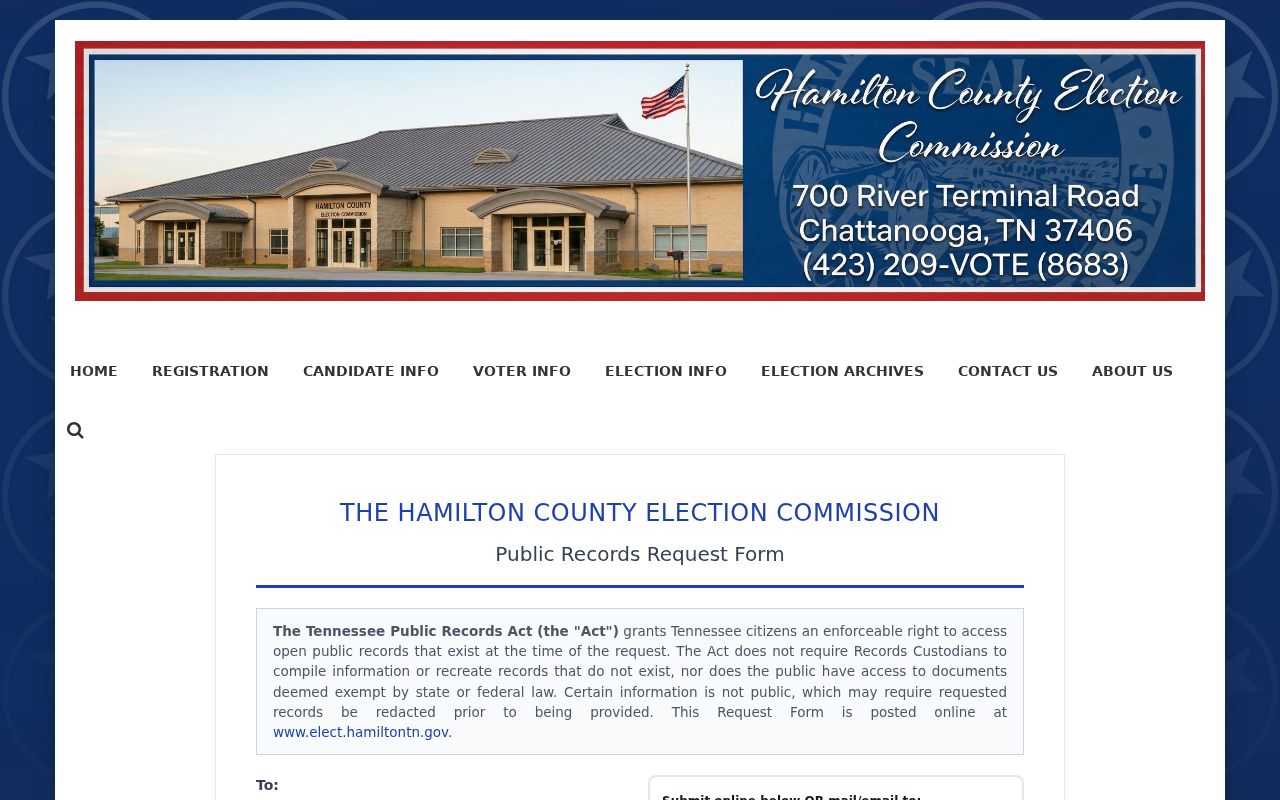
The screenshot reinforces why a narrow record description and delivery choice matter. It also separates inspection from a copy or duplicate request.
Note: Ask for an existing extract and its layout; the Election Commission is not required to produce a new report or custom analysis.
Why Chattanooga Voter Records Change
A missing result can arise from spelling, county selection, a pending application, a move, or a name update. It can also reflect inactive or cancelled status. Tennessee uses address-confirmation and returned-mail procedures under state law and the National Voter Registration Act. Under the federal safeguard, a person generally cannot be removed solely for not voting.
After an address-confirmation notice, removal for nonresponse requires the applicable waiting period across two federal general elections, plus failure to vote or update the registration. Other events follow different rules. Death, confirmed relocation, duplicate registration, a disqualifying felony status, a written request from the voter, or adjudicated incompetence may support cancellation.
The Hamilton County Election Commission is the authoritative place to resolve the record. Its main site links local election services and contact information.
The office view provides a direct fallback when the statewide lookup cannot explain a status, recent change, precinct assignment, or no-match result.
Chattanooga Protected Voter Addresses
The Tennessee Safe at Home program gives an official substitute address to eligible survivors of domestic abuse, stalking, trafficking, rape, sexual battery, and other qualifying offenses. It is administered by the Secretary of State and is available at no cost. State and local agencies use the substitute address while the actual address stays confidential.
Participants follow special voting steps, including absentee-by-mail provisions, to avoid exposing a residence. The program does not change identity, move a participant, or erase an address that appeared in an older public record before enrollment. Requesters must honor the protection. Searching around it or trying to connect a substitute address back to a residence defeats the law’s safety purpose.
Note: A common address field in a voter roll is never a reason to assume every Chattanooga residence may lawfully be disclosed.
Chattanooga Ward 2 Voter History
Current voter rolls are not the only route for local history. The UTC Finding Aids describe a “Chattanooga Ward 2 voter registration list,” identifier CHC-1975-146, dated 1941 through 1943. It belongs to the Chattanooga History Collections and can place a resident within a ward whose political geography may not match today’s districts.
The online entry is a finding aid, which means it describes the collection rather than exposing every name and field. Search by the collection title or identifier. Then inspect any linked digital item or ask UTC Special Collections about the physical container. Result entries may show title, dates, collection area, scope, identifier, and container information.
Historic poll books and registers document presence or participation in a place, never vote choice. For other Hamilton County election returns and registration material, search Tennessee State Library and Archives catalogs and local archive holdings. No verified single online run of Hamilton County poll-book years was found, so confirm each series and date range with its repository before drawing a family or neighborhood conclusion.