
Which Chattanooga Records Are Open
Chattanooga is the Hamilton County seat, so the city name on a record does not reveal its custodian. The city holds its own correspondence, permits, police reports, and municipal cases. County offices hold recorded land instruments, assessment rolls, marriage licenses, most trial cases, and local custody files. Tennessee agencies maintain statewide certificates, correction records, and professional or business indexes. The access channel changes with the record set.
| Chattanooga record | Official keeper | Web access | Access route |
|---|---|---|---|
| Deeds, mortgages, liens, plats | Hamilton County Register of Deeds | Paid Online Record Search | $50 monthly remote access or free office inspection |
| Property assessment and tax | Hamilton County Assessor and Trustee | Free owner, address, and parcel searches | Web search, bulk roll, or office inquiry |
| Trial and municipal cases | Division clerk or Chattanooga City Court | Several free division-specific portals | Portal, docket, clerk counter, or copy request |
| Birth, death, marriage, divorce | Tennessee Vital Records and local offices | Applications, not a general name index | Eligibility, identification, and fee apply to recent certificates |
| Jail, correction, registry | Hamilton Sheriff, TDOC, and TBI | Free tools with distinct scopes | Portal or agency records request |
| City administrative and police files | City of Chattanooga or Police Department | Open Records Center | Browse, submit, and track a request |
An online result is often an index rather than the official document. A deed citation can lead to an image, and a court result can lead to the clerk's file. Recent vital certificates, adoption files, juvenile material, sealed or expunged cases, protected addresses, and confidential identifiers do not become open merely because related records are public. Motor vehicle personal data also has separate federal and Tennessee restrictions.
How Chattanooga Applies Open Records
The Tennessee Public Records Act, Tenn. Code Ann. §§ 10-7-501 through 10-7-518, starts with access to state, county, and municipal records unless another law closes them. Its enforceable inspection right belongs to Tennessee citizens. A custodian may ask for identification that establishes state citizenship. The law applies to an existing file. It does not require an office to answer questions, do research, create a list, or rebuild a missing record.
Inspection during business hours generally carries no charge, though lawful redaction costs may arise under an office policy. Copies, delivery, and labor beyond the adopted threshold may cost money. If a record cannot be made available promptly, § 10-7-503 requires a response within seven business days. The office must produce it, deny access in writing with the legal basis, or state the reasonable time needed. Seven business days is a response point, not a promise that every request will be complete.
A denial can be taken to the Tennessee Office of Open Records Counsel for help or mediation. Judicial enforcement is available under § 10-7-505 in chancery or circuit court. Narrowing a broad request and asking for redacted, separable portions may resolve a dispute sooner.
Note: Each Chattanooga and Hamilton County custodian maintains its own written request and fee policy, so one office's terms do not control another.
Hamilton Register Records Split Access
The Hamilton County Register of Deeds records deeds, mortgages, liens, plats, powers of attorney, marriage settlements, military discharges, and other instruments authorized by Tennessee law. Its access model has an unusual split. Public inspection is free at the office, yet sustained remote database use requires an application, password, and $50 monthly payment. The public welcome page does not state a complete earliest index year.
The official instructions document seven search modes. Party mode requires dates and defaults to July 1, 1969 through the present. Book and Page works best when a citation already came from the assessor. “GI” means General Index, while `P%` searches across plat indexes. Results link book-and-page citations to document images, with PDF as the durable viewing choice.
| Register field or mode | Entry type | Requirement | Chattanooga search note |
|---|---|---|---|
| Search type | Mode selector | Required | Party, Book & Page, Document, Property, Party/Property, Index, or Quick |
| Party | Name text | Mode dependent | Grantor, grantee, or another indexed party |
| Date range | Date pair | Required in Party mode | Defaults to 07/01/1969 through present |
| Document group/type | Dropdown | Optional | Narrows results; the full list is behind login |
| Book & Page | Citation pair | Mode dependent | Use a known citation; GI means General Index |
| PDF or TIFF | Image option | Optional | Controls the linked document image format |
The split is easy to miss: a record may be public even when the remote index is not free. Call 423-209-6560 or visit Room 400 at 625 Georgia Avenue when a subscription makes little sense. The Register also publishes monthly sales and mortgage reports and offers a free property-fraud alert by person name or property address.
Chattanooga Property Records Without Guesswork
The Tennessee Property Assessment Data portal supplies a free first view of Hamilton County parcels. Basic search accepts county plus an owner name, property address, or parcel ID. Advanced search adds subdivision, classification, sale dates, and parcel components. A parcel is assessment evidence, not proof of title. The situs address identifies the land, while the owner's mailing address is where assessment correspondence goes.
The Hamilton County GIS viewer adds parcel geometry and geographic context, but a map layer should not be assumed active unless it appears in the live viewer. Carry the parcel ID and deed book/page from the assessment result into the map and Register systems. That keeps three distinct records tied to the same parcel.
Chattanooga Property Index Quirks
Current assessment data comes through two paths. TPAD supports one-parcel searching, while Hamilton County publishes a bulk roll that refreshes about every 30 days. The larger file suits broad civic analysis; the portal is simpler for one owner or address. The Assessor is the correction and detail fallback at 423-209-7300.
A multi-owner indexing quirk can hide a valid result. Hamilton assessment records index a deed under the first person named, so a search for a co-owner may fail. Search the address or parcel ID next. Then carry the book/page citation to the Register. The Trustee search is another fallback when an address fails; omit the street suffix and test the exact stored form before deciding the parcel is absent.
Note: A Chattanooga postal address may fall outside city limits, so use parcel jurisdiction or GIS rather than ZIP wording to choose the custodian.
Chattanooga Court Records by Division
There is no single court index for every Chattanooga matter. Circuit and General Sessions Civil cases use free, immediately updated Tennessee Case Finder. General Sessions Criminal and Criminal Court use the Hamilton criminal case search, with last, first, and middle name fields. Chancery publishes current dockets, while the Clerk and Master holds the fuller file. Chattanooga City Court handles municipal matters separately. State appeals appear in the Tennessee appellate portal, and federal cases use PACER.
Choose the division before treating a no-result as meaningful. General Sessions Criminal handles misdemeanor and traffic judgments plus preliminary felony hearings. Criminal Court handles indicted or appealed criminal matters. Circuit covers civil disputes, name changes, divorce, and other assigned cases. Chancery covers estates, trusts, guardianships, liens, boundary matters, and delinquent taxes. Juvenile, adoption, sealed, confidential, and expunged material is not an ordinary name-search source.
If the portal fails, inspect current docket PDFs, then contact the clerk with the name, case number, rough dates, and exact document sought. Circuit Court is at 625 Georgia Avenue, 500 Courthouse, 423-209-6700. The Clerk and Master is in Suite 300 at the same address, 423-209-6600. The original clerk file, not an informational web docket, reflects later changes.
When Chattanooga Vital Records Open
Tennessee certificates are not a general public database. Under Tenn. Code Ann. § 68-3-205(e), births become public after 100 years. Death, marriage, divorce, and annulment records become public after 50 years. Older material moves into Tennessee State Library and Archives channels. Current certificates remain subject to relationship, identification, and proof rules. A court divorce file and a state divorce certificate are different records.
The Tennessee Vital Records application center provides separate forms for birth, death, marriage, and divorce or annulment certificates.
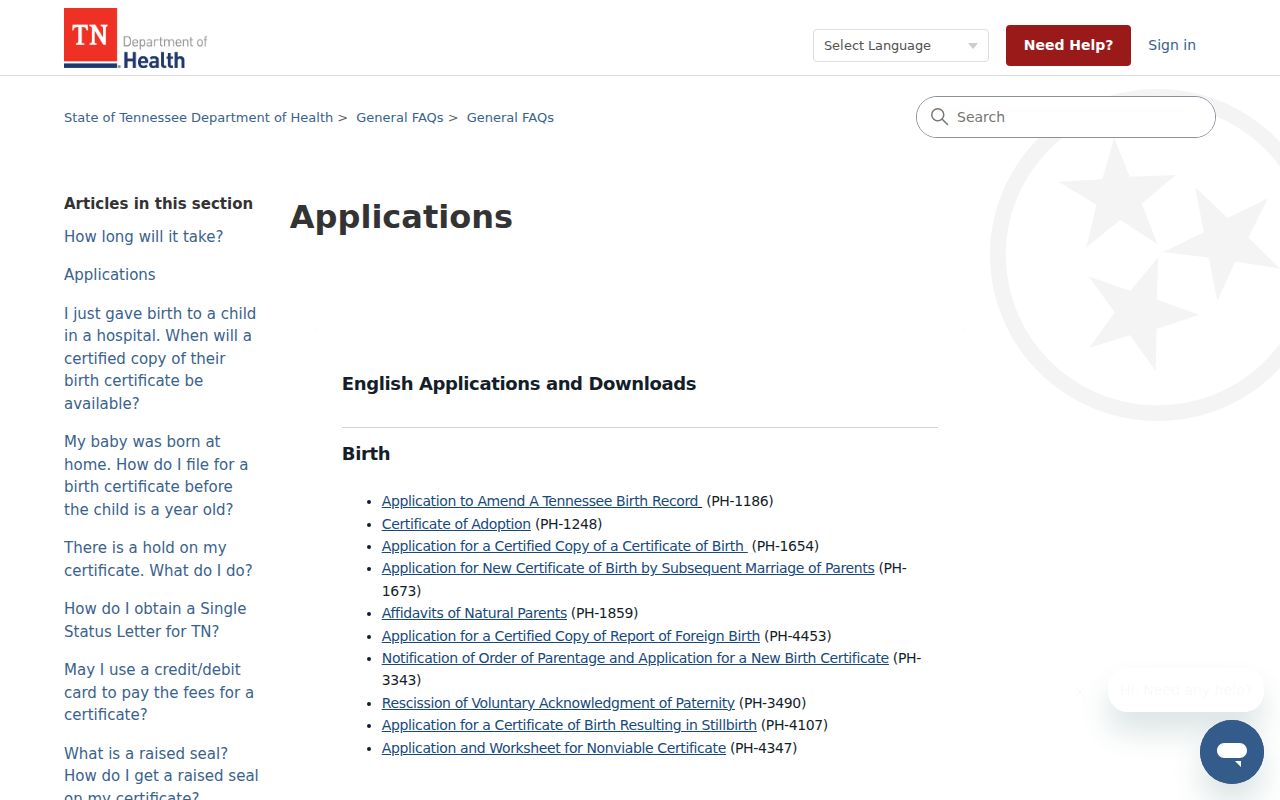
The application choices reinforce the access split: each event has its own form, and a requester must use the form tied to the certificate and qualifying relationship. The state search fee is $15 and includes one certified copy if found; a no-record letter costs the same. Mail applicants generally submit valid identification or use notarization as the form directs. Hamilton County Health Department is a local route for registered Tennessee birth and death certificates, regardless of the event county.
Chattanooga Public Records Custodians
A precise request starts with the office that created or keeps the file. Most central county offices are in the courthouse complex on Georgia Avenue, while City Court sits on Market Street. Online channels can save a trip, but clerk counters remain the authoritative route for certified copies and records beyond portal scope.
Hamilton County Register of Deeds
625 Georgia Avenue, Room 400
Chattanooga, TN
423-209-6560
Deeds, liens, mortgages, plats, and recorded instruments
Hamilton County Clerk
625 Georgia Avenue
Chattanooga, TN
423-209-6500
Marriage licenses, business licenses, and county clerk records
Hamilton County Circuit Court Clerk
625 Georgia Avenue, 500 Courthouse
Chattanooga, TN
423-209-6700
Circuit and General Sessions Civil files and copies
Chattanooga City Court Clerk
600 Market Street, Room 104
Chattanooga, TN
423-643-7541
Municipal cases, citations, and city dockets
The Chattanooga Open Records Center routes city, police, and police-report requests and lets users browse and track submissions. County deeds, assessment rolls, jail files, and most court cases should not be sent there. Confirm the jurisdiction and record type first.
Chattanooga Custody Records Have Limits
Three official systems answer three different questions. The Hamilton County inmate tool searches current local custody by last name or SPN and can display a full inmate list. Tennessee's Felony Offender Information Lookup covers people now or formerly in Department of Correction felony custody. The TBI registry is a separate status-based database that updates daily. None is a complete lifetime criminal history.
Booking information and custody status do not establish guilt. Filed charges, court action, and disposition belong to the right criminal clerk and case portal. For an incident report, the Sheriff provides a web request route, a Records Office at 423-209-7111, and an open-records email channel. More than seven law-enforcement agencies have jurisdiction in Hamilton County, so confirm which agency created the report. Some official video requests go first to the District Attorney for approval.
Chattanooga Records Fees Depend on Format
Free inspection does not make every copy free. Circuit Court lists plain copies at 50 cents per page, certification and seal at $5, and exemplified copies at $10 plus 50 cents per page. Chancery charges nothing when a request totals up to $3, then 50 cents per page, with certified photocopies at $5 plus page charges. Tennessee Vital Records charges a nonrefundable $15 search fee. The Register's remote database costs $50 per month, while its office inspection remains the practical short-use fallback.
City and agency requests may include copy, delivery, programming, redaction, or labor charges under an adopted policy. Ask for an estimate before authorizing copies. A request for inspection only can avoid copy costs, and narrowing dates or record types can reduce labor. Court fee schedules or a statute may override the statewide reasonable-charge guidance, so the quoted custodian controls.
- Index
- A finding list that points to a file; it may not contain the official document.
- Certified copy
- A copy authenticated by the keeper for uses that require official proof.
- Custodian
- The office responsible for keeping and responding for a specific record.
- Exemption
- A state or federal rule that closes a record or requires protected facts to be removed.
Note: State and county fees change by record and format; obtain a written estimate instead of applying one office's price to another.
Closed and Redacted Chattanooga Records
Tennessee's open-records presumption has firm boundaries. Adoption and juvenile files, sealed or expunged cases, recent vital certificates, confidential motor-vehicle and tax data, protected voter identifiers, and some personal facts about protected officials remain closed or redacted. The statewide Safe at Home program gives eligible survivors a substitute government address and mail forwarding. It does not erase older records, but agencies and requesters must protect the participant's actual address.
The Tennessee Information Protection Act, effective July 1, 2025, provides rights against covered private data controllers, subject to thresholds and exemptions. It does not erase a deed, court filing, or government file maintained under public-record law. When an official image exposes a protected identifier, contact the custodian about proper redaction. Do not alter the official image or assume access permits threats, repeated unwanted contact, intimidation, or harassment.
Requesting Chattanooga Public Records
Use a portal when it has the needed date and record. Otherwise, write to the custodian under the TPRA. Identify an existing file rather than asking the office to answer a question. State whether inspection or copies are wanted, include a narrow time span, and name the subject, address, case number, permit number, or other search key. Be ready to establish Tennessee citizenship if requested.
- Identify the city, county, court, or state office that created or keeps the exact record.
- Check its live portal, docket, request policy, and stated coverage before drafting a request.
- Describe the record type, date range, subject, useful identifiers, and preferred delivery method.
- Choose inspection or copies, review the estimate, and prepay when the policy requires it.
- If access is denied, ask for the legal basis and separable portions. Narrow the request or seek Open Records Counsel help.
Lawful use. Open access supports civic review, family history, estate work, and consumer safety. Never use a Chattanooga record to stalk, harass, threaten, or harm another person.
A portal miss is not proof that no record exists. It may fall before web coverage, sit under a name variant, belong to another division, or require counter access. The custodian can confirm archives, microfilm, certification, and the correct request route without turning the request into open-ended research.